
Safe Amalgam Replacement
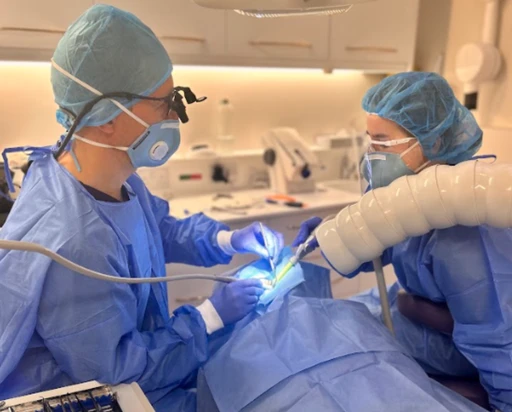
We take replacing amalgams very seriously. We take every precaution necessary to minimise any mercury exposure not only for you, but also for us. We are guided by the International Academy of Oral Medicine and Toxicology (IAOMT) protocol called the Safe Amalgam Replacement Removal Technique (SMART).
What is Dental Amalgam?
Amalgams are metallic dental fillings consisting of approximately:
Once the most commonly used restorative material in dentistry, its use has declined since the 1980s with the advent of tooth-coloured materials such as composite resin and porcelain.
Though dental amalgams are long-lasting and economical, there have been growing concerns over the potential medical and environmental impacts of their use — due to the mercury content to some — including possible links to Alzheimer's disease, multiple sclerosis, other neurobehavioural changes and autoimmune diseases.
Case Study — Replacing Residual Amalgam Safely
This 60-year-old woman was interested in amalgam replacement and had some replaced elsewhere, but was unsure if the dentist was undertaking the correct precautions and questioned the quality of the composite resin used. Her last lower right molars had multiple composite resin patch-ups which collectively appeared worn with loss of contour and form, and a suspicious grey tinge in the tooth structure underneath.
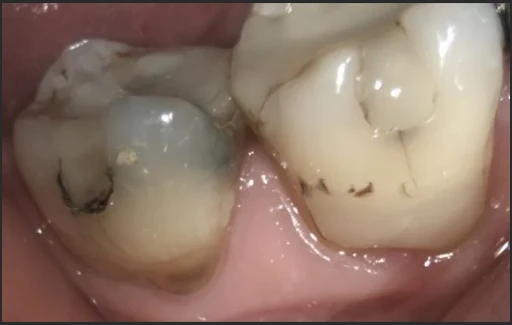
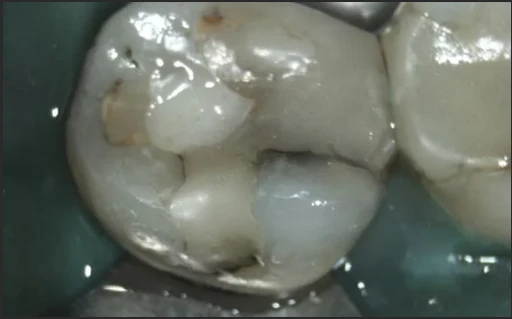
Worn composite patch-ups with grey tinge in the underlying tooth structure
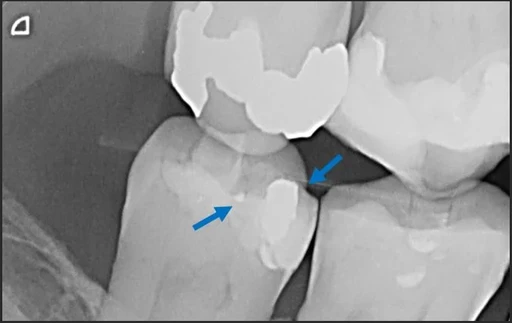
X-ray confirmed amalgam left behind by the previous practitioner. The blue arrows indicate where the residual amalgam remained.
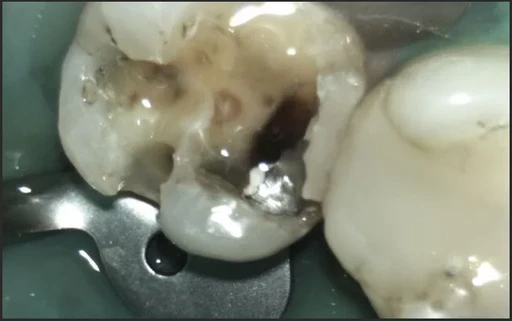
Upon taking the necessary SMART precautions, there was considerable amalgam remaining as well as secondary decay.
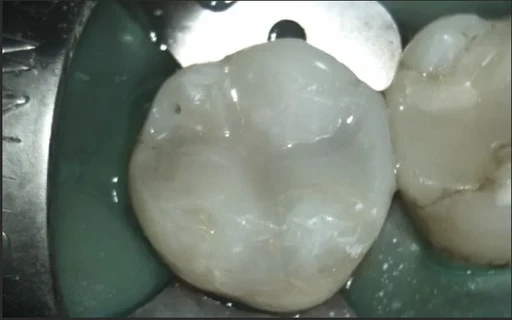
After complete removal of residual amalgam and decay, composite resin was placed replicating the natural form of the original tooth.
Despite all precautions we undertake — e.g. non-latex rubber dam and IQ Air Purifier with activated carbon filter — there will likely be some exposure to all parties during the process. We are happy to co-ordinate with your health practitioners to ensure the best possible care is taken.
If you have been interested in replacing your amalgams, there is no better time. The first step is to book in for a consultation and take x-rays. We can always request previous x-rays at a different practice, as long as they are relatively recent — e.g. within the last 18–24 months.
Ready to replace your amalgam fillings safely?
Book a Consultation Appointment